

What Is a Supermoon and When Is the Next One
A Supermoon happens when a Full Moon or New Moon is near the Moon's closest approach to Earth; also called perigee
Next Supermoon in January 2018
The Wolf Moon on the night between January 1 and January 2, 2018 is a Supermoon.
A Super Full Moon looks around 12% to 14% bigger than its counterpart, the Micromoon, and up to 7% bigger than an average Full Moon.
A Red Blue Moon
The following Full Moon, on January 31, is almost a supermoon, according to timeanddate.com's definition (see below) and, for all intents and purposes, it will look like a Supermoon.
More importantly, on this Full Moon night, there will be a total lunar eclipse in some areas, including most ofNorth America, Asia, Australia, and more.
It is also a Blue Moon, as the January 31 Full Moon is the second Full Moon of the month. A totally eclipsed Moon usually looks red, so this may be a rare opportunity to see a red Blue Moon.
Where is the total lunar eclipse on Jan 31, visible?
Perigee and Apogee
The Moon's orbit around Earth is not a perfect circle, but elliptical, with one side closer to Earth than the other. As a result, the distance between the Moon and Earth varies throughout the month and the year. On average the distance is about 382,900 kilometers (238,000 miles).
The point on the Moon's orbit closest to Earth is called the perigee and the point farthest away is the apogee.
How can Full Moon be in the daytime?
Super Full Moon and Super New Moon
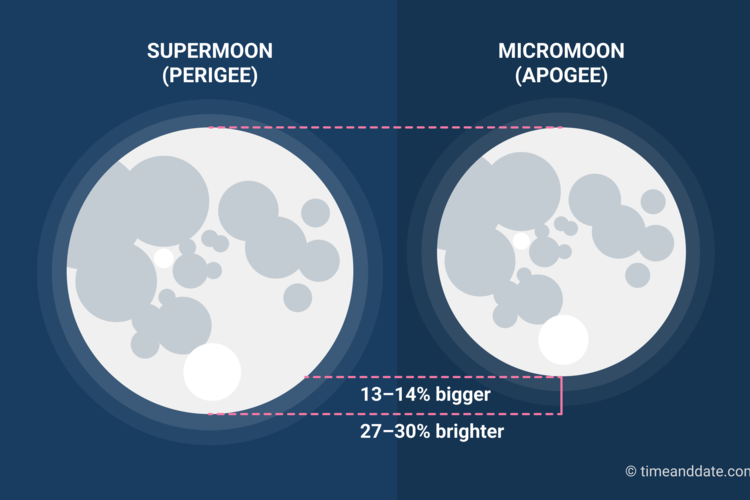
A Supermoon looks larger than a Micromoon.A Super Full Moon looks larger than a Micromoon.
When a Full Moon takes place when the Moon is near its closest approach to Earth, it is called a Super Full Moon. When there is a New Moon around the closest point to Earth, it is known as a Super New Moon.
A Micromoon, on the other hand, is when a Full or a New Moon is near its farthest point from Earth, around apogee. It's also known as a Minimoon, Mini Full Moon, or a Mini New Moon.
Not an Official Name
Supermoon is not an official astronomical term. It was first coined by an astrologer, Richard Nolle, in 1979. He defined it as ‘a New or a Full Moon that occurs when the Moon is at or near (within 90% of) its closest approach to Earth in its orbit’. It is not clear why he chose the 90% cut off in his definition.
Supermoon Definition
There are no official rules as to how close or far the Moon must be to qualify as a Supermoon or a Micro Moon. Different outlets use different definitions. Due to this, a Full Moon classified as a Supermoon by one source may not qualify as a Super Full Moon by another.
The following definitions are used at timeanddate.com:
- Supermoon: A Full or New Moon that occurs when the center of the Moon is less than 360,000 kilometers (ca. 223,694 miles) from the center of Earth.
- Micromoon: A Full Moon or New Moon that takes place when the center of the Moon is farther than 405,000 kilometers (ca. 251,655 miles) from the center of Earth.
The precise values for years 1550–2650 are that a Super Full Moon's angular size is 12.5%–14.1% bigger than Micro Full Moon, and 5.9%–6.9% bigger than an average Full Moon.
Astronomical terms & definitions
Technical Name: Perigee-syzygy
The technical term for a Supermoon is perigee-syzygy of the Earth-Moon-Sun system. In astronomy, the term syzygy refers to the straight-line configuration of three celestial bodies. Another name is perigee Full Moon.
When the Moon is close to the lunar nodes of its path during a syzygy, it causes a total solar eclipse or a total lunar eclipse
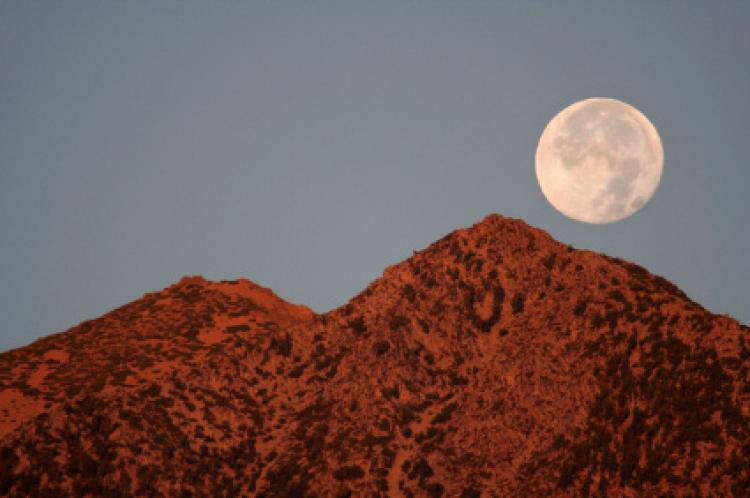
The Full Moon looks larger near the horizon.The Moon near the horizon looks larger than when the Moon is higher in the Sky, a phenomenon known as the Moon illusion.©iStockphoto.com/Jason Woodcock
Looks Bigger and Brighter
Because it's so close to Earth, a Super Full Moon also looks about 30% brighter than a Micro Full Moon and about 16% brighter than an average Full Moon.
The Supermoon on November 14, 2016, was the closest since January 26, 1948. The next time a Full Moon will come even closer to Earth is on November 25, 2034 (dates based on UTC time).
Moon Illusion: Best at Moonrise and Moonset
The best time to enjoy a Super Full Moon, or any other Full Moon, is just after moonrise, when the Moon is close to the horizon. Just before moonset is also a good time.
When the Full Moon is low, it looks bigger and brighter than when it's higher up in the sky. This is called the Moon Illusion, and actually makes more of a difference to what it looks like than the real boost you get from it being a bit closer to Earth.
Higher Tides at Supermoon
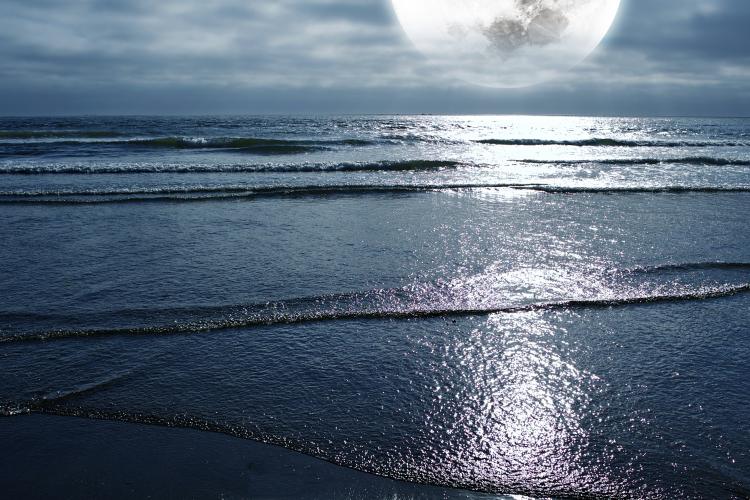
The Moon's gravitational pull causes tides.The Moon's gravitational pull causes tides.©bigstockphoto.com/duallogic
The greatest difference between high and low tide is around Full Moon and New Moon. During these Moon phases, the gravitational forces of the Moon and the Sun combine to pull the ocean’s water in the same direction. These tides are known as spring tides or king tides.
Supermoons lead to around 5 cm (2 inches) larger variation than regular spring tides, called perigean spring tides.
The tidal range is smallest during the two Quarter Moons, known as neaps or neap tide.
Natural Disaster Trigger?
Although the Sun and the Moon’s alignment cause a small increase in tectonic activity, the effects of the Supermoon on Earth are minor. Many scientists have conducted studies, and they haven’t found anything significant that can link the Super Moon to natural disasters.
According to NASA, the combination of the Moon being at its closest and at Full Moon, should not affect the internal energy balance of the Earth since there are lunar tides every day.
Super Moon Dates
| Year | Date |
|---|---|
| 2018 | Tuesday, 2 January |
| 2019 | Monday, 21 January |
| 2019 | Tuesday, 19 February |
| 2020 | Monday, 9 March |
| 2020 | Wednesday, 8 April |
Super Full Moons can vary by time zone. Dates above are based on the local time in Tehran. Change location