

what the Great Depression reveals about our future
It was the biggest setback to the global economy since the dawn of the modern industrial age. But did the world’s reaction worsen the effects of the 1929 Crash? And have we learned from those mistakes?
As the summer of 1929 drew to a close, the celebrated Yale university economist Irving Fisher took to the pages of the New York Times to opine about Wall Street. Share prices had been rising all year; investors had been speculating with borrowed money on the assumption that the good times would continue. It was the bull market of all time, and those taking a punt wanted reassurance that their money was safe.
Fisher provided it for them, predicting confidently: “Stock markets have reached what looks like a permanently high plateau.” On that day, the Wall Street Crash of October 1929 was less than two months away. It was the worst share tip in history. Nothing else comes close.
The crisis broke on Thursday 24 October, when the market dropped by 11%. Black Thursday was followed by a 13% fall on Black Monday and a further 12% tumble on Black Tuesday. By early November, Fisher was ruined and the stock market was in a downward spiral that would only bottom out in June 1932, at which point companies quoted on the New York stock exchange had lost 90% of their value and the world had changed utterly.
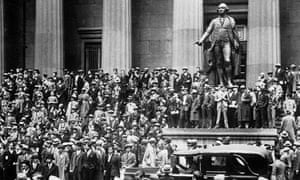
The Great Crash was followed by the Great Depression, the biggest setback to the global economy since the dawn of the modern industrial age in the middle of the 18th century. Within three years of Fisher’s ill-judged prediction, a quarter of America’s working population was unemployed and desperate. As the economist JK Galbraith put it: “Some people were hungry in 1930 and 1931 and 1932. Others were tortured by the fear that they might go hungry.”
Banks that weren’t failing were foreclosing on debtors. There was no welfare state to cushion the fall for those such as John Steinbeck’s Okies – farmers caught between rising debts and crashing commodity prices. One estimate suggests 34 million Americans had no income at all. By mid-1932, the do-nothing approach of Herbert Hoover was discredited and the Democrat Franklin Roosevelt was on course to become US president.
Across the Atlantic, Germany was suffering its second economic calamity in less than a decade. In 1923, the vindictive peace terms imposed by the Treaty of Versailles had helped to create the conditions for hyperinflation, when one dollar could be exchanged for 4.2 trillion marks, people carted wheelbarrows full of useless notes through the streets, and cigarettes were used as money. In 1932, a savage austerity programme left 6 million unemployed. Germany suffered as the pound fell and rival British exports became cheaper. More than 40% of Germany’s industrial workers were idle and Nazi brownshirts were fighting communists for control of the streets. By 1932, the austerity policies of the German chancellor Heinrich Brüning were discredited and Adolf Hitler was on course to replace him.